Configured for your business, not just switched on.
Each of these is a working system we adapt to how you actually operate — your units, your approvals, your documents, your GST setup. That usually takes weeks rather than the months a build from scratch would, and it arrives with your existing data migrated, your team trained and a named person to call.
Six builds, six different problems. None of them started as a specification — they started as someone explaining how their day actually goes.
01
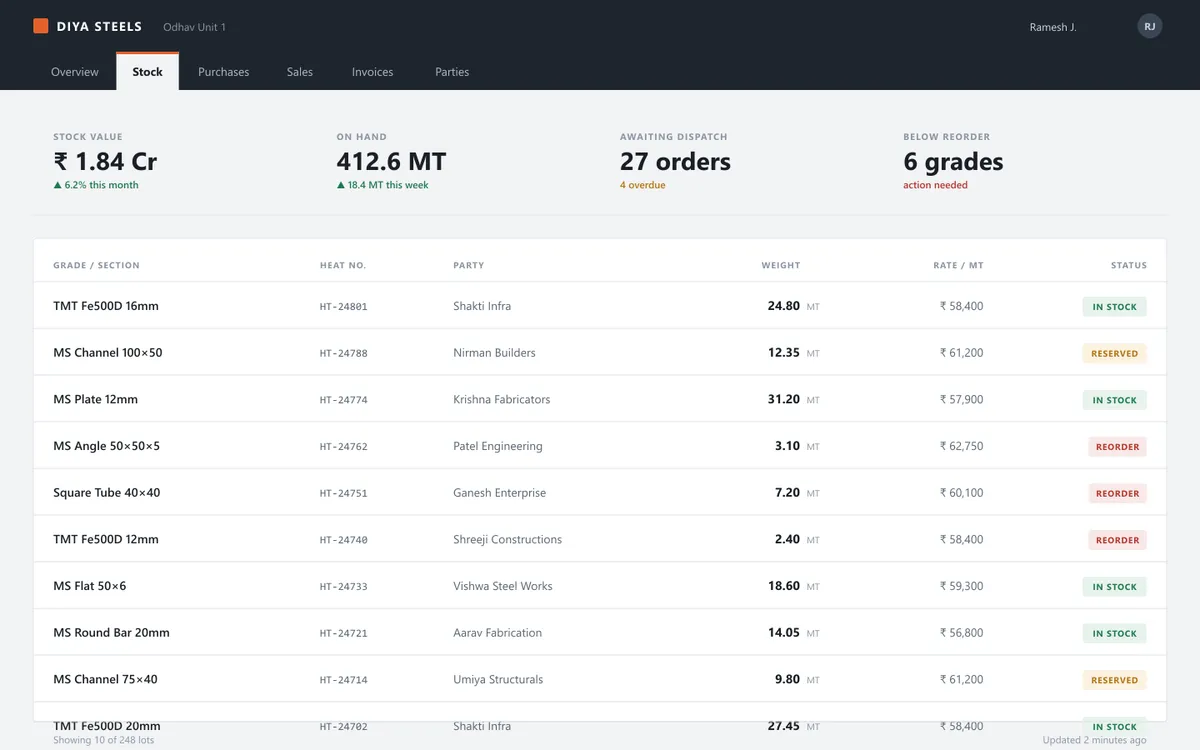
Inventory system
Know what is in the godown, what it cost and what it is worth — at any hour, without a Saturday spent proving it against a paper register.
Stock by grade, section and heat number, so a site engineer asking six months later gets an answer in seconds
Purchases, sales and returns in one ledger — no second register to reconcile
A GST invoice generated straight from the sale, with no re-typing
Reorder alerts before a grade runs out, not after a customer is turned away
02
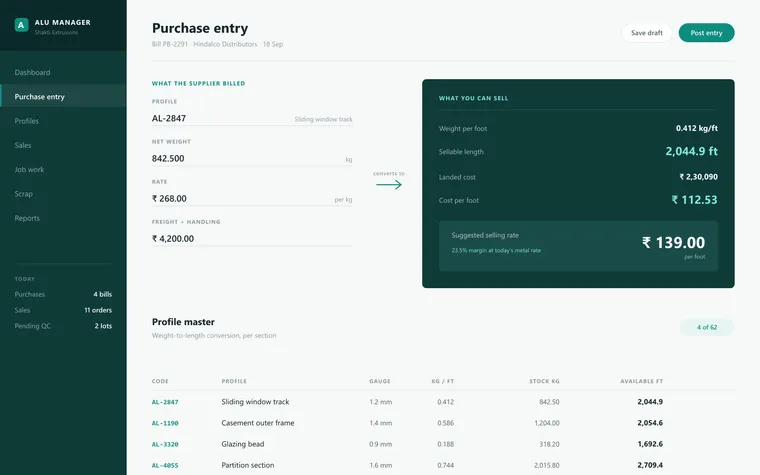
Business ERP
Quote a customer in seconds and see your margin before you commit to a rate — even though you buy by weight and sell by length.
Enter the supplier bill exactly as it reads; the sellable length works itself out
A true landed cost per foot, freight included, so no quote is guessed
Section-wise margins that hold up when the metal rate moves overnight
03
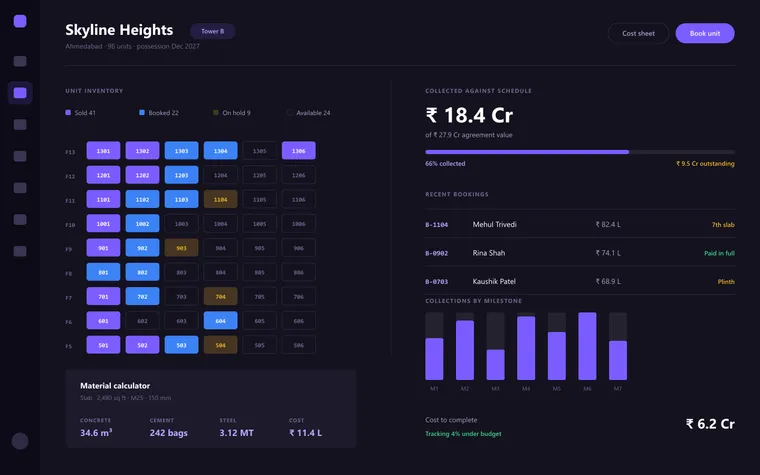
Construction ERP
Answer "where do we stand on this project?" from one screen, instead of three phone calls and a spreadsheet someone forgot to send.
Every unit in the tower colour-coded: sold, booked, on hold, available
Payment schedules tied to construction milestones, so collections do not slip
Material and labour calculators that give a builder a number on the spot
04
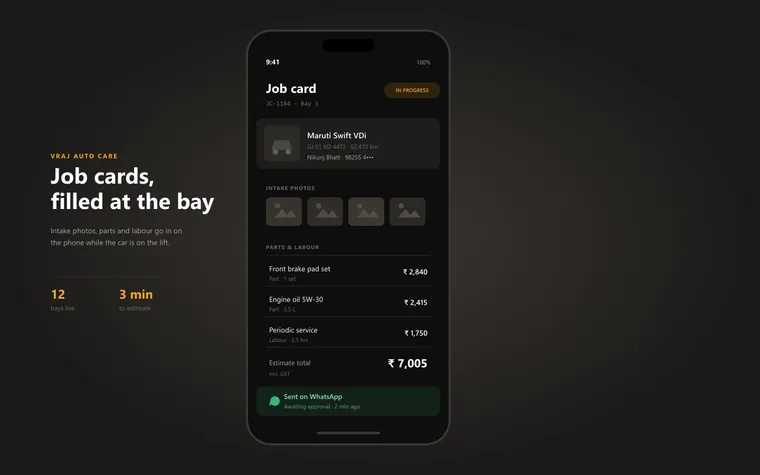
Workshop system
The estimate reaches the customer on WhatsApp before a spanner is picked up — and comes back approved in minutes rather than days.
Job cards filled in on a phone at the bay, not copied up later
Intake photos attached to the card, ending arguments about pre-existing damage
05
AI product
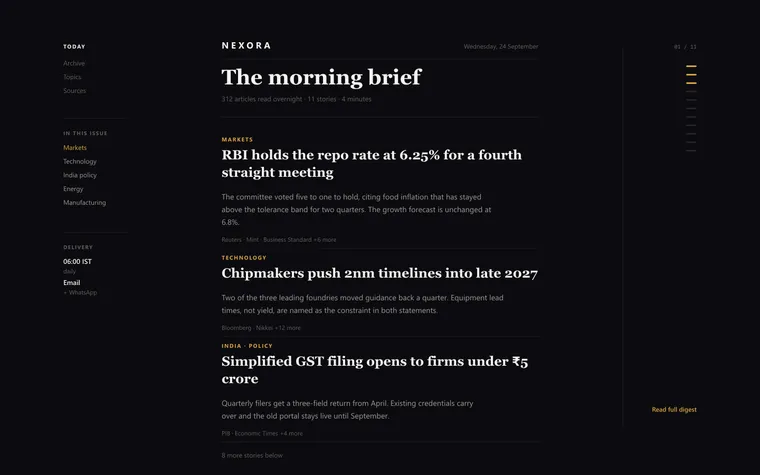
Twenty minutes of morning reading compressed into three, with a source link under every line so nothing has to be taken on faith.
The same story across a dozen outlets collapsed into one entry
Every claim linked back to the article it came from
06
Online store
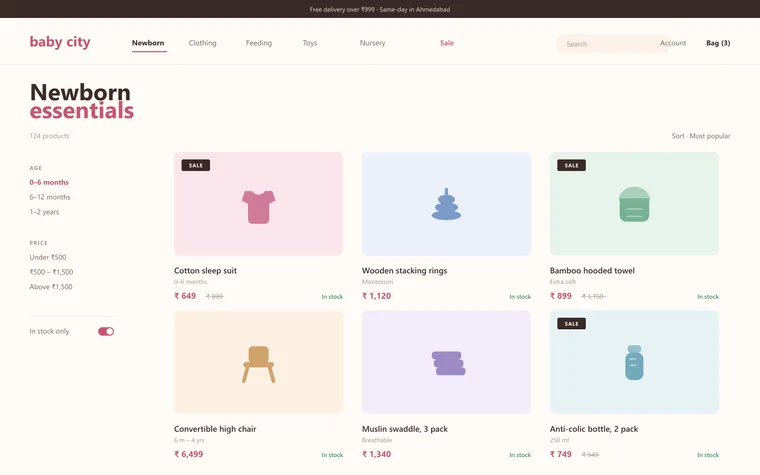
Sell online without keeping a second stock register — the storefront and the shop counter draw on exactly the same inventory.
One catalogue and one stock count shared with in-store billing
UPI, card and cash-on-delivery, because customers here use all three
Your business is probably not on this list.
That is fine — none of these existed until someone described a problem on a call. If your work involves stock, units, orders, sites or customers that do not fit a packaged system, the shape of the answer is usually clear within one conversation.
Cosmora Systems is an engineering studio in Gujarat. We build business software that speaks the language of the trade it serves.
Most software asks a business to change how it thinks. A steel trader works in grades and heat numbers. An aluminium business buys by the kilogram and sells by the foot. A builder thinks in towers, floors and units. Packaged systems flatten all of that into a generic "item" — and the workarounds that follow, the parallel register, the WhatsApp group, the Saturday spent reconciling, quietly become part of the job.
We start from the opposite end. Before a line of code is written we learn how the work is actually done, then build a system around it. Scope is agreed in writing, you approve the screens before they are built, and a working version is in your hands every week — so there is never a six-month silence followed by a surprise.
That fit is the whole point. A system shaped around how the work is actually done gets used; one that fights the process gets worked around until nobody trusts the numbers in it. So the early weeks go into your units, your approvals and your documents — and we stay involved long after launch, because the systems worth building are the ones that keep being extended.
Harsh Patel
Founder & Lead Engineer
Harsh leads engineering at Cosmora Systems and works alongside the team on every build. He is currently delivering inventory, billing and ERP systems for trading and manufacturing businesses across Gujarat.
Every project is scoped by the person who will build it. If that is me, you will know on the first call.
01
Built for your units
Kilograms, feet, bundles, heat numbers, floors. We model what you actually count instead of forcing a generic "item" on you.
02
You see it every week
A working build in your hands each week, not a status report. If something is going the wrong way you find out in week two, not month five.
03
Plain answers
Clear scope, clear pricing and a clear reason behind every technical choice. If something is a bad idea we say so early — including when saying so means a smaller project for us.
04
Supported in writing
Each build ships with a warranty period, full documentation, training for your team and a named person to call. Support is in the contract, not a favour.
05Questions
Answers before you call
The things people ask us first — cost, timelines, ownership and what happens after go-live.
What does Cosmora Systems do?
Cosmora Systems is a software company in Gujarat, India that builds custom business software and sells four ready systems: Manufacturing ERP, Manufacturing CRM, an Inventory Management System and an AI Chatbot. We also handle website design and development, AI and ML solutions, AI automation, digital marketing, graphic design and UI/UX design.
How much does a custom ERP or inventory system cost in India?
For a small or mid-sized business, a working system is usually eight to sixteen weeks of work, and the price moves with scope rather than user count. What drives it: how many units and conversions you use, how much old data has to be migrated, how many people use it differently, and which integrations you need. We give a range within one working day of a call.
How long does it take to implement a manufacturing ERP?
Because our ERP is an existing system configured to your business rather than written from scratch, implementation typically takes weeks rather than months. The time goes into mapping your bill of materials, units and approvals, migrating existing stock and party data, and training your team — not into building base features.
Which industries do you build software for?
We work mainly with trading, manufacturing, distribution and construction businesses — steel and metal traders, engineering and fabrication units, aluminium and extrusion businesses, builders and developers, wholesalers and retailers. The common thread is a business whose stock, units or approvals do not fit a packaged system.
Can the software handle different buying and selling units, like kilograms and feet?
Yes, and this is a core design decision rather than an add-on. Each item holds the unit you buy in and the unit you sell in, with the conversion built in — so you enter a supplier bill exactly as it reads in kilograms and the system tells you the sellable length in feet, along with your true cost per foot.
What is an AI chatbot and how would it help my business?
An AI chatbot answers customer questions automatically on your website or WhatsApp, using your own catalogue, specifications and pricing. It handles the repetitive questions about size, rate and delivery at any hour, captures the customer’s requirement as a structured lead, and passes anything it cannot answer to your team.
Do you work with businesses outside Gujarat?
Yes. We are based in Gujarat and work with businesses across India. Most of a project runs over calls, screen shares and weekly demos, so location rarely affects the work — and we travel for the discovery and go-live stages when a project needs it.
Will the system work with my existing Tally or Excel data?
Yes. Migrating existing data is part of every implementation. We import item masters, party lists, opening stock and outstanding balances from Tally exports or Excel, clean up duplicates and inconsistent naming as part of the process, and reconcile the opening position with you before go-live.
What support do you provide after the software goes live?
Every build ships with a warranty period, full documentation and training for your team, and a named person to call. After that, support runs on an annual maintenance arrangement covering fixes, updates and small changes — the terms are in the contract rather than left informal.
Tell us what you need built
Share your idea on a call or WhatsApp. We reply within one working day.